
Don’t Panic — Travel
There is a moment before every trip that rarely gets talked about.
The apartment is still the same.
The suitcase is open.
But your thoughts are already somewhere else.
Everything feels intensified: the noise of the city, the silence of the room, the quiet doubt that something essential will be forgotten.
Your mind is overloaded, while the suitcase is either packed with the wrong things or suspiciously empty.
There is always something missing. Always the one thing no one thought of.
But that moment is not really about travel.
It’s the moment when fear checks whether it still has control.
Not the fear of airplanes, borders, or foreign languages — but the fear of a disrupted rhythm.
The fear that something inside you might shift… and that you won’t know exactly how to return to who you were.
Because at home, everything is familiar.
You don’t have to prove yourself.
You don’t have to push through crowds, negotiate prices, wonder if someone is trying to take advantage of you, or question whether you’ve missed the “real experience.”
At home, the world has edges.
Outside, it often feels like one endless crowd.
And maybe that’s exactly why we postpone travel — not because we can’t go, but because we’re afraid of who comes back afterward.
The fear of change often disguises itself as a reasonable concern.
(→ Learning that transforms)
London: The City That Doesn’t Adjust
London doesn’t wait for you to catch your breath.
It keeps moving — not to push you away, but because it assumes you’re capable of joining in.
At first glance, the pace feels unforgiving: people walk fast, eyes collide without apology, trains arrive and depart without explanation. And yet, beneath that surface, there is something unexpectedly gentle.
The city seems to understand that no one can do everything at once, so it offers pauses without asking questions.
London’s parks are not decorations.
They are rhythm.
Hyde Park, Regent’s Park, St. James’s — places where the city lowers its voice for a moment, and you realize that constant motion is not a requirement for belonging. The benches are not there just for resting, but for watching. For a brief presence without purpose.
In cities like this, one truth becomes clear:
You are not the center — but you are an equal passerby.
And there is something deeply liberating in that.
London doesn’t ask you to “see it all.” It allows you to approach it in fragments: one street in the morning, one bookshop in the afternoon, one unplanned hour sitting in a park.
When you let go of the need to document everything, the city stops being overwhelming and becomes a quiet conversation.
This may be why London works surprisingly well for people who fear crowds and constant interaction — because it doesn’t force engagement. It grants you the right to observe. To be silent while in motion.
Panic doesn’t disappear because the world slows down.
It disappears when you stop competing with its pace.
A Book That Walks the City
Mrs Dalloway by Virginia Woolf is not a novel of dramatic turning points.
It is a book about thoughts that unfold while walking — while passing shop windows, entering parks, standing at the edge of one’s own memories.
The entire story takes place over a single day in London. The city is not merely a backdrop; it is an accomplice. Streets, parks, bells, passersby, and urban sounds enter the characters’ inner monologues and shape them. External order runs parallel to internal unrest, without any obligation to resolve it.
One day becomes an entire life.
Outer structure does not guarantee inner calm.
Social roles exist as quiet pressure, not spectacle.
Virginia Woolf knew this city intimately — not as a tourist destination, but as a landscape of thought.
Virginia Woolf’s Time Map & Literary London
1882 — Born in London (Kensington)
Born on January 25th in London, a city that would later become the central current of her literary consciousness.
1904–1910 — Bloomsbury, London
Living in Bloomsbury, near the British Museum and vibrant intellectual circles. This part of the city — with its squares and streets — is directly woven into the social and mental map of Mrs Dalloway.
Here, the idea of the city as a space where thoughts collide more quietly than people takes shape.
1919–1941 — Monk’s House, Sussex
Retreating into quiet allowed distance. Although the novel is set in London, the calm of Sussex gave structure and clarity to its inner monologues.
1925 — Publication of Mrs Dalloway
The novel follows one London day — with parks like Hyde Park, urban sounds, and constant movement that never stops, yet never demands total surrender.
How to Read London Through Mrs Dalloway
(for a future visit to the city)
- Walk without a destination. Look for transitions between streets, not landmarks.
- Stay in a park. It’s where the city and the mind breathe at the same rhythm.
- Observe people without the need to understand them. That’s where Woolf begins.
Reading this book before a trip — or during it — teaches you that London doesn’t need to be conquered. It only needs to be allowed to flow through you.
📚 This is not a book we read to escape —
but one that teaches us how to remain present while moving.
The Thinking City: History, Parks, and Quiet Layers
London is a city built in layers, like a book where every page holds a surprise. Its story begins nearly two thousand years ago, when the Romans founded Londinium — a settlement along the River Thames, with bridges and arches that still whisper of first encounters with the water.
The city grew, survived fires, plagues, and wars, and every stone carries traces of human struggle and ordinary life.
Today, London is not only history — it is a blend of rhythm, silence, and small secrets. Its museums guard stories that never make the posters:
- The British Museum holds artifacts once protected by the Romans and the Egyptians, its corridors sheltering quiet portraits of distant civilizations.
- The Victoria and Albert Museum is not just about art, but about life itself — fabrics, jewelry, instruments, objects that whisper of human desire and ambition.
- Tate Modern shows how contemporary art can narrate a city’s rhythm and dissonance, much like Woolf’s inner monologues.
Looking out of museum windows, walking through parks, or following the Thames reveals many Londons within London.
Hyde Park is where the city pauses, if only briefly.
St. James’s Park murmurs of times when monarchs walked the same paths.
Regent’s Park balances calm and creativity with effortless grace.
For Woolf admirers, Bloomsbury — with its quieter streets and cafés — still carries intellectual tension and the breath of the era in which her novel was formed.
The Thames flows through the city, connecting spaces, while bridges — from Tower Bridge to Millennium Bridge — link history and the present, people and stories, creating an invisible rhythm for anyone who walks their span.
Crossing these bridges, it’s easy to imagine Clarissa Dalloway’s inner monologue — or Virginia Woolf’s own footsteps, shaped equally by city and silence.
In London, nothing is accidental — not the order of the streets, not the chaos of crowds, not the quiet of a park. They are layers that remind us that a city, like a person, never stops teaching us how to stay present while moving.
From London to Iron Gates: A Journey Through a Portal
Imagine walking through London’s streets — through Bloomsbury, past Hyde Park — while thoughts flow the way they do in Virginia Woolf’s Mrs Dalloway.
The city moves. The rhythm doesn’t ask whether you’re ready. People collide and pass, and you observe the world through the author’s lens — one day becoming an entire life, every detail a paragraph in London’s invisible book.
And then, somewhere between a building and a bridge, between the sound of traffic and the silence of a park, a portal opens.
You don’t see it with your eyes, but you feel it — in the tension of your shoulders, in the breath of a river that seems to call you. You step through, and suddenly you are standing on the banks of the Danube River, facing the cliffs of the Đerdap Gorge (Iron Gates Gorge).
London’s rhythm pours into the river’s flow. Panic dissolves. Boundaries become clear. Golubac Fortress rises like a stone from a legend, reminding you that control once had its purpose — but was never meant to be permanent.
Nature does not react to our anxiety, and that is precisely what calms us. In this space, it becomes easier to lower your shoulders. Panic has no one to negotiate with. Rhythms exist before us and after us.
Passing through this portal, travel becomes experience. Space speaks without words. History reveals itself through sight. Legends float in the air. Every cliff, every view of the Danube, every path through the fortress becomes a new page — read not with the eyes, but with the heart.
One-day journeys like this through Đerdap are not escapes.
They are exercises in regulation — reminders that movement can exist alongside safety, that space can change without chaos, and that fear can become strength rather than malfunction.
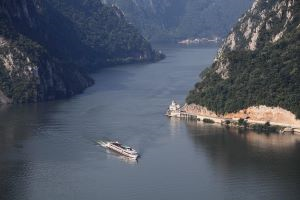
Space as a Book
Iron Gates may not have a novel attached to it the way London does, but the landscape carries its own narrative.
The Danube is a line of history.
Legends of Golubac Fortress whisper stories of love and defense. Travel literature such as Patrick Leigh Fermor’s Between the Woods and the Water concludes precisely at this narrowing of the river — a place where Europe changes its rhythm.
Here, space speaks without words — about borders, passages, and encounters.
Not all books live on shelves.
Some are read through sight, breath, and silence.
Quotes & Short Reflections for the Journey
Notes from Underground — Fyodor Dostoevsky
“Man loves to suffer, to struggle with himself and the world, because only then does he feel that he exists.”
At times, standing on the cliffs of the Iron Gates Gorge, this thought becomes tangible. The river moves relentlessly. The cliffs do not yield. And you understand that patience and introspection are not weaknesses.
Strength does not lie in domination, but in presence — in sensing the world’s rhythm without the need to fight it.
Between the Woods and the Water — Patrick Leigh Fermor
“Sometimes the road moves more slowly than we expect, but it is in those steps that we discover history, culture, and ourselves.”
Sailing through the Small Kazan Gorge and gazing at Trajan’s Tablet, the landscape tells its own story. Rivers, cliffs, and remnants of civilizations are not scenery — they are protagonists.
Travel is a teacher, and nature’s pace is the most patient classroom.
A Time of Gifts (Walking to Constantinople) — Patrick Leigh Fermor
“Every path holds a story, every horizon carries an untold legend.”
Like Fermor discovering Europe step by step, standing on Kapetan Miša’s Hill and drifting through the gorge teaches you that landscapes carry knowledge not stored in books.
Careful observation can be as powerful as reading — often leading to deeper truths.
Iron Gates Through the Eyes of Books
Can you imagine a place where the Danube narrows so much that rock and water whisper centuries-old stories? Where cliffs seem to guard secrets thousands of years old?
A one-day tour through the Iron Gates takes you exactly there — through a space that reads like a novel, where every view is a paragraph.
The journey begins with a quiet morning departure from Novi Sad or Belgrade, but soon it stops being an ordinary trip. The bus moves steadily as the city’s rhythm gives way to the river’s flow.
And just as Dostoevsky observes inner monologues, you begin to observe the inner current of the river, the cliffs, and history itself.
Before you rises Golubac Fortress — stunning in its restoration, yet with walls that still whisper of emperors, soldiers, and negotiations that shaped Europe’s borders.
Pay attention to the stone blocks, passages, and towers — every detail carries time, like paragraphs in a book read outdoors.
As sunlight glides across the Danube, you reach Kapetan Miša’s Hill. The view takes your breath away: the gorge stretches into the distance, while the secrets of Vlach cuisine wait to be discovered like pages of an old manuscript hidden long ago.
It feels as though the landscape itself guides your thoughts. The Danube leads you into stories of the Small Kazan, of King Decebalus, and Trajan’s Tablet — details that make the life of the river and cliffs tangible. You don’t just see history — you walk it, breathe it, feel it.
This journey is not just about travel.
It is exploration, a moving journal, a lesson in patience and rhythms that existed long before us — and will continue long after.
Through nature, you understand yourself.
Through history, you discover the world.
Through the panorama, you encounter a beauty that remains long after your eyes return home.
Micro-Adventure
ℹ️✨ This post contains affiliate links. Some links may earn a small commission for SoTheWay if you choose to make a purchase — at no additional cost to you. We only recommend resources and brands that align with mindful values and genuine usefulness.
You don’t have to go far.
You don’t even have to “take a lesson” from it.
Sometimes it’s enough to take a one-day walk through your city, with a book in your bag.
Sometimes it’s enough to spend an hour in a park — without a destination, without photos.
When was the last time you went somewhere without a plan — and without the pressure that it had to mean something?
Small journeys train the same skills as big ones: tolerance for uncertainty, patience, and presence. As your feet move slowly, your mind opens doors to new ideas and memories — much like the pages of a well-chosen book.
Travel with a Book and a Planner
Whether you’re sitting in an armchair with a notebook, sketching a small adventure, or walking slowly through a park, imagine yourself as a character in a book.
- Through planners and journals, you record inner currents of thought — much like Dostoevsky exploring the psychology of his characters.
- Your backpack carries your travel “tools,” the way Patrick Leigh Fermor carried lists and maps while walking across Europe.
- An armchair or a quiet resting place creates a rhythm of return — where calm allows reflection, much like the stillness of Sussex gave Virginia Woolf space to think after London’s intensity.
Every micro-adventure is, in essence, a small portal — one that lets you explore both the world and yourself.
And here, affiliate links are not just about buying something.
They are bridges — to your next story, your next book, your next journey.
A thoughtfully chosen book supports the movement of the mind.
A planner or journal gives shape to experience.
Small rituals — before or after travel — help the body follow where curiosity leads.
Travel doesn’t always begin with a destination.
Sometimes it begins with a page, a pen, and the quiet decision to step into your own story.
Intergalactic Footnote 🌌
A note for travelers:
If you’re waiting to feel calm before you leave, you probably never will.
The world has its own rhythm. Join it.
Travel is not only movement through geography.
It is movement through dimensions: the outer world, the inner world, and the space in between moments — what we at SoTheWay call experience portals.
- London is a portal for thought and urban rhythm.
- Đerdap Gorge (Iron Gates) is a portal for breath, history, and nature-based contemplation.
- A micro-adventure in a park can be a portal into the creative space of the mind.
🌌 The SoTheWay Philosophy: Traveling Through Dimensions
- The dimension of space:
It’s not about how far you go, but how attentively you walk. Every street, every viewpoint, every path holds a story — one you can read with your eyes, your heart, and your thoughts. - The dimension of time:
Every adventure, even a single-day one, carries a rhythm that existed before you and will continue after you. Don’t try to rush it. Step into it. - The introspective dimension:
Books, notebooks, planners, and thoughts are your tools for recognizing what’s inside and what’s outside. Every journey is an exercise in presence — learning how to walk through the world and through your own thoughts at the same time.
Through these portals, you learn that:
- Fear is not an obstacle, but a sensor and a compass.
- The world’s rhythms exist even when we forget to follow them.
- Some “roads” lead more through inner silence than through kilometers.
So the next time you pack a backpack, pick up a planner, or slip a book inside — remember:
You’re not just moving through space.
You’re moving through dimensions of yourself and the world. 🌌
Returning Home
How do you know the journey wasn’t an escape?
By the fact that you return with a greater ability to stay.
Not with more photos — but with a wider tolerance for uncertainty.
Travel doesn’t solve everything.
It doesn’t erase fear, remove doubt, or rewrite life plans.
But it teaches you how to observe them from a different angle.
As you walk London’s streets, watch the Danube slide through the gorge, or sit quietly in a park with a book or planner — you learn that movement itself is the lesson.
You return with the understanding that panic doesn’t take control just because the world doesn’t stop for you.
That rhythm exists even when you pause — and that you can always find your own current within it.
Sometimes it’s enough to breathe.
To notice.
To be where you are.
Travel also teaches you that boundaries are flexible.
Those you thought were holding you back are often there to remind you of your own strength — that you can move through uncertainty, crowds, heights, and cliffs without losing your footing.
And when you finally return home, you may notice something subtle:
The world is the same, but your eyes are different.
Your capacity to stay present in chaos has grown.
Your hands know that sometimes the goal isn’t arrival, but movement.
Your heart knows that sometimes it’s enough not to panic while moving.
And truly — sometimes, that is more than enough.
Conclusion
Travel — whether through cities, rivers, or your own thoughts — teaches us that the world’s rhythm is not something to conquer, but something to follow.
Every step, every glance, every breath becomes part of a lesson in presence: the freedom to be where we are, and the courage to keep moving without fear.
In that simplicity lies the true power of travel.
No matter the distance or the time spent away, travel remains a portal — one that teaches you how to see both the world and yourself with greater calm, clarity, and presence.
SoTheWay is more than a blog. It’s a guide for your everyday small victories.
✨ Explore the entire SoTheWay galaxy →Frequently Asked Questions (FAQ)
What is mindful travel, and how is it different from regular travel?
Mindful travel focuses on presence rather than distance. Instead of rushing through destinations, it encourages slow movement, observation, and emotional awareness. The goal is not to see everything, but to experience places — and yourself — more deeply.
How can travel help with fear, anxiety, or mental stagnation?
Travel doesn’t eliminate fear, but it helps you relate to it differently. By changing environments and rhythms, travel trains tolerance for uncertainty, patience, and self-regulation. Even small journeys can reduce mental stagnation by offering new sensory input and perspective.
What is a micro-adventure and why does it matter?
A micro-adventure is a short, simple journey — often close to home — such as a walk through a park, a one-day trip, or an unplanned city stroll. These experiences provide many of the benefits of longer travel, including mental clarity, creativity, and emotional reset.
Do I need to travel far for personal growth?
No. Personal growth through travel is not about distance. It’s about attention. A local park, a nearby river, or a familiar city explored differently can offer just as much insight as international travel.
Why are books important for travel and self-discovery?
Books support introspection and reflection. Literary travel — reading before or during a journey — helps you slow down, observe more carefully, and connect inner thoughts with outer movement. A book can act as a guide, not to places, but to perception.
How does slow travel improve the travel experience?
Slow travel allows time for emotional processing, observation, and rest. Instead of maximizing activities, it prioritizes rhythm and presence. This approach often leads to deeper memories, less stress, and a stronger connection to place.
Is this type of travel suitable for solo travelers?
Yes. Mindful and slow travel are especially suitable for solo travelers, as they encourage self-awareness, observation, and independence without pressure for constant interaction or performance.
What does “travel as personal growth” really mean?
Travel as personal growth means using movement as a tool for self-awareness. It’s not about transformation through achievement, but about learning how you respond to change, uncertainty, rhythm, and unfamiliar environments.
Can travel help even if I feel overwhelmed or anxious before leaving?
Yes — and waiting to feel calm before traveling often means never going. Mindful travel accepts anxiety as part of the process and teaches you to move with it, rather than against it.
How do planners or journals support mindful travel?
Planners and journals help structure experience without controlling it. Writing before or after a journey supports reflection, emotional clarity, and memory integration, turning travel into a conscious, meaningful process.