
The Art of Deep Focus in the Era of Distraction
In the modern age, the ability to focus deeply on a task has become our most valuable currency. While the digital world forces us to be “available and fast,” true progress in learning happens in moments of deep work. We often believe we lack motivation or simply possess an “inferior brain,” but the truth is simpler: we lack the rituals that guide that brain.
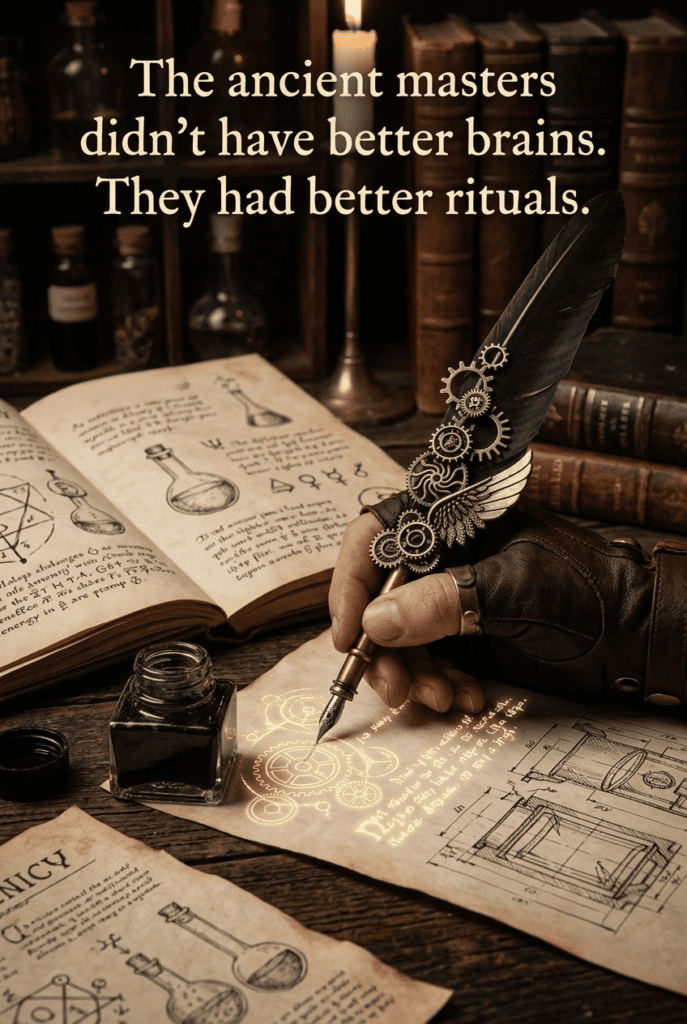
The history of learning and science teaches us that ancient masters did not possess superior biology; they possessed superior rituals. A ritual serves as a cognitive switch—it eliminates the “switching cost” between tasks and allows the brain to immerse itself in complex topics without resistance.
The Psychology of Ritual: Why You Need a “Trigger”
Our brains love patterns. When we apply the same ritual before learning—whether it’s organizing our desk, turning on a specific lamp, or picking up a dedicated writing tool—we send an unambiguous signal to our nervous system: Now is the time for deep focus.
This is a vital skill for every modern autodidact. Instead of waiting for inspiration, you build a system that invites it. Ritual writing, combined with tools that demand conscious attention, slows down thought processes and eliminates the need for “digital crutches.” It is a practice of internal discipline that transforms knowledge from fleeting information into permanent intellectual capital.
The Psychology of “Ancient Masters”: Anatomy of Focus
When we study the lives of great thinkers and autodidacts of the past, we notice an interesting pattern: their productivity was not the result of sheer willpower, but of a carefully constructed environment. These masters didn’t have “better brains” than us; they simply knew how to “trick” them. By using a specific pen, particular dim lighting, or absolute silence, they created cognitive triggers that instantly shifted their brains into a state of high efficiency.
This process requires taking responsibility for your own learning. As we explored in our guide on how to become your own teacher, taking control of the educational process is the first step toward autonomy. Furthermore, the art of choice is crucial—the decision to consciously reject the noise of the digital world in favor of a space where thoughts can develop. If you have already explored the importance of setting boundaries in our article on the analog rhythm, now is the time to apply that discipline to your deep learning sessions.
Ritual as a “Start Button” for the Brain
To achieve a state of deep focus, your brain needs a clear physical signal. This doesn’t have to be complicated; it just needs to be consistent. Physical preparation—clearing your desk, turning off phone notifications, and grabbing an inspiring tool—creates a mental space where distractions lose their power.
When you hold a specific tool in your hand, such as a steampunk-inspired pen, you are not just writing words; you are permitting yourself to be focused. That tactile moment is your “start button.”
Discover Your Tool for Deep Focus
Your Treasury of Knowledge
Understanding these principles is just the beginning. To turn these techniques into a long-term practice, we invite you to explore our resource hub. Here you can find tools and materials carefully curated to support your path toward knowledge:
Let this process become a habit. For further discussion on how you apply these rituals in your daily work, join us on our YouTube channel or get in touch—we love hearing how members of our community build their little universe of knowledge.
Integration into the SoTheWay System: From Ritual to Lasting Value
Creating your own learning ritual is not an isolated act; it is the foundation upon which you build your entire structure of knowledge. To master this skill, we recommend exploring our Learning That Changes category, where we focus on techniques that transform information into applicable experience. A learning ritual is the first step toward creating a “system” that works for you, not against you.
Once you establish the discipline of deep focus, it naturally overflows into all segments of your life—including how you view long-term projects. Just as learning requires patience and focus, smart resource management requires a long-term perspective. You can find an example of this thinking in our analysis of the Treesury Token and Investment, where the focus is not on quick gains, but on building a sustainable future through patience and discipline. Your ability to focus deeply today is a direct investment in your “treasury of knowledge” tomorrow.
Conclusion: Your Treasury of Knowledge
A learning ritual is, in its essence, an act of respect toward your own intellect. In a world that demands superficiality and speed, consciously slowing down and directing your attention becomes our most powerful tool. Let your rituals be the ones that open the door to deeper understanding and lasting intellectual progress.
To deepen your research and find tools that will accompany you on this path, explore our Treasury of Knowledge hub, where curated resources are intended for those who are building their own little universe.
Let this be just the beginning of your transformation. For further discussion, sharing experiences, or asking questions about your learning process, we invite you to visit our YouTube channel or contact us. Your path to knowledge is unique, and we are here to support it.
Frequently Asked Questions (FAQ)
What is “deep work” and why is it important?
Deep work is the ability to focus without distraction on a cognitively demanding task. It allows you to quickly master complex information and achieve better results in less time.
Can I develop a “deep work” ritual if I am a beginner?
Yes, anyone can develop this skill by consistently setting aside a specific time, place, and using a ritualistic tool—like a dedicated pen—that signals to your brain that it is time to focus.
How does ritual writing help with mental clarity?
By slowing down the writing process, you force your brain to filter information more effectively, which reduces the “noise” and chaos of digital data.
Where can I find more resources on long-term focus and goal setting?
You can explore our Treasury of Knowledge hub for curated tools and resources designed to support your journey toward autonomy and disciplined learning.