
The modern human spends more than eight hours a day in front of screens, leading to a state that experts increasingly define as digital fatigue. Constant availability, a relentless influx of information, and notifications that interrupt our thought processes not only diminish productivity but also drain our cognitive resources in the long run. When attention is fragmented, the capacity for deep thinking—a key skill for every modern autodidact—is lost.
The solution does not lie in abandoning technology entirely, but in consciously introducing an analog rhythm into everyday life. An analog rhythm represents a deliberate return to slower activities that require physical presence and focus, acting as a necessary shield for maintaining mental health in a hyper-connected society. It is the moment when technology is silenced, and the individual reconnects with their own flow of thought.
The Psychology of Ritual: Returning to Oneself
The need for “offline” moments is deeply rooted in human psychology. Without periods of rest, the brain loses the ability to process information and consolidate knowledge, which directly impacts health literacy and general well-being. Education regarding the importance of rest is not a luxury, but a fundamental discipline for anyone striving for mental clarity and long-term progress.
Discover the Universe of Health and Beauty
Rituals, such as handwriting, act as “anchors” that return us to the present moment. Unlike typing on a keyboard, the physical act of writing engages synesthesia—a combination of tactile sensation, movement, and sight—which is proven to reduce stress levels and foster creative problem-solving. In a world that favors speed, ritual writing becomes a subversive act of internal discipline. This is not merely a matter of technique; it is a way to establish order in the chaos of information and ensure that the knowledge we acquire becomes a part of us, rather than just fleeting data on a screen.
The Art of Writing as a Secret Skill
In a world where communication speed is measured in milliseconds, handwriting takes on the characteristics of a forgotten, almost esoteric skill. While digital tools encourage superficial scanning of information, handwriting forces the mind into a process of slow contemplation. This deceleration is not a waste of time; it is a process of cognitive filtering. When a pen touches paper, the thought process is structured, focus becomes sharp, and the capacity for deep learning—the primary skill of every modern autodidact—increases significantly.
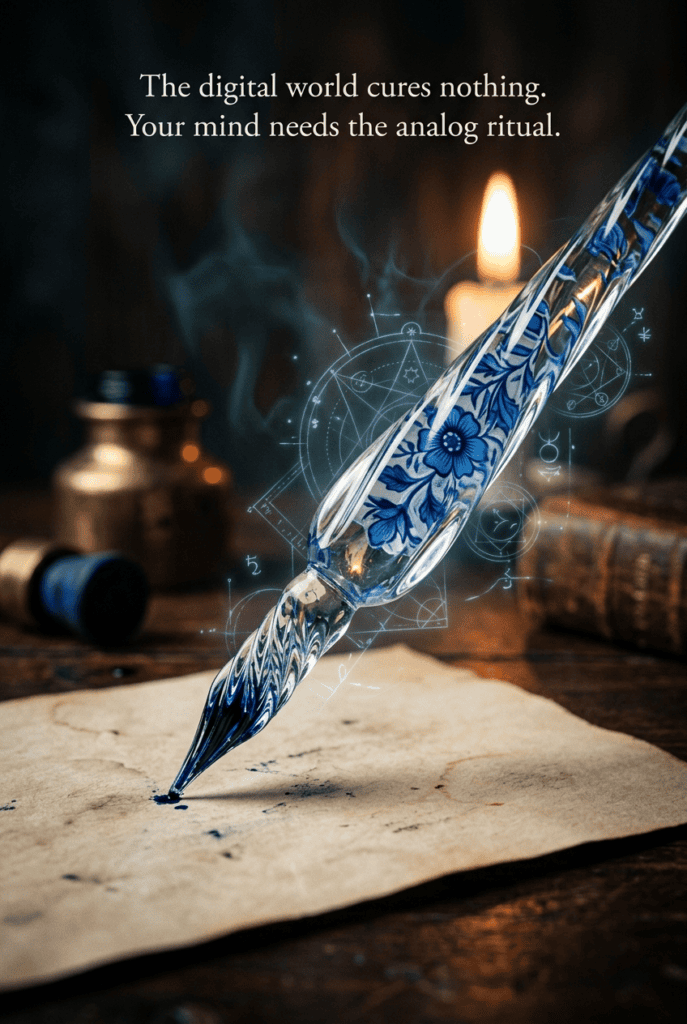
There is a special kind of internal discipline in the ritual of writing that recalls the practices of ancient secret societies, where knowledge and thoughts were carefully guarded and shaped. This ritual requires an adequate tool—an instrument that serves not just to transfer ink to paper, but to create an experience. A glass pen, with its elegant design and precise tip, becomes the central element of this ritual. It transforms the mere act of taking notes into an artistic endeavor, providing a tactile satisfaction that digital devices will never be able to replicate. By using such a tool, the individual consciously enters a space where thoughts crystallize, and learning becomes permanent.
For those striving to build their own analog ritual and looking for tools that combine aesthetics and functionality, more information on these specific writing instruments can be found below:
Discover Your Tool for an Analog Ritual
This approach to writing is not just about productivity; it is about the conscious cultivation of intellectual autonomy in a time that demands we be anything but focused.
Building Your Analog Corner: A Path to Conscious Living
Creating an “analog corner” is not just an aesthetic choice; it is the architecture of your personal space for reflection. To master this skill, it is important to immerse yourself in content that supports your authentic development. We invite you to visit our Adventures with Meaning category, where we share experiences on finding purpose beyond digital frameworks, as well as our Our Little Universe category, which offers inspiration for creating spaces that reflect your deepest values.
This process requires a high level of internal discipline. As analyzed in our articles on the Art of Choice and the experiences that shape a modern autodidact, freedom of choice in the digital age is the greatest luxury we possess. Discipline is not a limitation but a tool that allows you to choose an analog instrument over a digital distraction consciously.
Conclusion: Your Treasury of Knowledge
An analog rhythm is not an escape from reality, but preparation for a better understanding of it. To deepen your research and find tools that will assist you in the process of learning and personal growth, explore our Treasury of Knowledge—a hub where carefully selected offerings support your path toward knowledge and autonomy.
Let this be just the beginning of your journey. For further discussion on personal development topics and to exchange experiences, we invite you to visit our YouTube channel or get in touch with us. Your questions and reflections are a vital part of our community.
Frequently Asked Questions (FAQ)
Is handwriting truly more effective for learning than typing?
Yes, scientific research confirms that handwriting engages specific cognitive processes that enhance memory retention and information comprehension.
How can I start with an “analog rhythm” if I have very little time?
Begin with “micro-rituals” lasting only 5 to 10 minutes a day, using a quality tool that inspires you.
Where can I find more resources for personal development and financial literacy?
All recommended resources and tools for the modern autodidact can be found in our Treasury of Knowledge hub.
What are the primary benefits of ritual writing?
Ritual writing helps reduce stress, fosters creative problem-solving, and serves as an act of internal discipline that brings order to information chaos.