
Architecture of Inner Peace: How to Discover Your Real Hourly Wage and Silence Consumer Noise
After silencing the external noise and understanding the psychology that drives our choices in our previous notes, it is time to draw the first lines on our personal blueprint. This text is not a manual that will tell you how to save money on your morning coffee with friends, because inner peace is not found in restriction, but in clear coordinates. We do not begin this research from a position of authority or as gurus promising quick millions; we observe things from the perspective of someone in midlife who is becoming deeply aware of the value of their invested time and wants to understand how to reduce financial stress through mindfulness.
Explore the Whole Galaxy of Transformative Learning
The financial peace we speak of here is not an abstract number on a screen. It is a quiet mental space. It is the ability of your inner being—the one standing behind all the social roles and masks you wear daily—to remain completely unperturbed and immune to external economic shocks. It is the transition from theory to the field, through a conscious journey of financial literacy from scratch.
 Coupon: 20% off $100
ℹ️✨ This post contains affiliate links. Some links may earn a small commission for SoTheWay if you choose to make a purchase — at no additional cost to you. We only recommend resources and brands that align with mindful values and genuine usefulness.
Dialogue in Ataraxia: A Meeting on the Edge of Silence
Between the pages of rough paper where the technical blueprint is drawn, and the warm aroma of olive tea slowly cooling on the table, I observe this quiet encounter from the sidelines. There is no competition, only the recognition of truth in the silence of a forest after the rain.
Your Money or Your Life – Vicki Robin & Joeo DominguezVicki Robin: “When you buy something you don’t essentially need, you aren’t spending paper money—you are spending the hours of your unique life energy that you had to invest to earn it.”
Veljko (slowly closing his eyes, touching the edge of the table with his fingers): “Heavy chains, disguised in shiny paper, big bills are. Space on the table and silence within, louder than the noise outside—that, true luxury is.”
When you strip away the social mask of an employee or a parent who must meet all societal expectations, only one naked question remains in the silence: What percentage of your tomorrow truly belongs to you, and how much have you sold to the system in advance?
Philosophy of Life Energy: The Hourly Wage of Your Being
Most of us live in an illusion dictated by an employment contract or a monthly bank statement. If your salary divided by official working hours yields a certain figure, your mind automatically believes that this is the value of your hour. But as autodidacts and researchers of reality, we know that consumer noise and mental health stand in direct correlation with the hidden costs we overlook.
To create a stable, one-page financial plan, we must calculate your REAL hourly wage.
A Blueprint for Field Calculation
Let’s take the example of an average professional in our modern environment, between 35 and 50 years old, who faces daily local financial pressures. To reach the truth, we must place the hours we truly dedicate to work on one side of the table, and the money that truly remains after we pay for the right to do that job on the other.
- Invisible Time (Adding Hours): Your workday does not last 8 hours. Add the time spent commuting through crowded city streets, the time needed to mentally prepare for the day over your first coffee, and the hours you spend outside of official working hours scrolling through business emails or decompressing from stress. Your 40 hours a week in reality often amount to 55 hours of your pure life energy.
- Invisible Costs (Subtracting Money): Now, from your monthly income, subtract the costs of fuel or public transit, the price of expensive clothes bought solely to meet a professional dress code, convenience food and quick coffees purchased because you lack the time to cook, and all the digital tools and subscriptions you pay for just to keep up with the pace of work.
When you divide the remaining, purified money by the total, actual number of hours, you get the figure that represents the hourly wage of your being.
This is your true shield of autonomy.
The Awareness Matrix: Money Transformed into Hours of Pure Life
Let’s imagine that after this calculation, your real hourly wage is $10 (or your local equivalent). The next time you face an impulsive choice, do not look at the price in currency. Run it through the filter of life energy:
| The Item / Choice You Make | Price | How many hours of your life does it actually cost? |
| Food delivery (because you are exhausted) | $50 | 5 hours of pure work and focus |
| New smartphone on contract (status symbol) | $1,000 | 100 hours (almost three weeks of work) |
| Impulsive online shopping (on the weekend) | $100 | 10 hours of your free time |
| Monthly subscription (that you rarely open) | $30 | 3 hours every single month, forever |
The next time you look at an object you desire to buy, ask yourself with a cool head, free of guilt: “Is this item worth 10 or 20 hours of my pure life, my absence from my family, and my creative focus?”
If it is, buy it with peace. If it isn’t, walk away. It is precisely this filter that instantly erases digital noise and sharpens the edges of your inner peace.
7 Baby Steps Purified from Noise
Once we realize the real price of our life energy, we can no longer look at the world through the same lens. Yet, awareness without structure is just another wandering thought. That is why we need to draw a clear plan—a local blueprint that eliminates the need for constant second-guessing and over-reliance on willpower. These seven steps are not a strict, aggressive diet; they are the architecture of your inner peace, calculated to remove systemic pressure and restore control over your own time.
Step #1: The Noise Shield (Fixed Beginner’s Emergency Fund: $1,000)
In international personal finance manuals, a thousand dollars is the gold standard for a beginner’s safety net. Before we even begin to think about clearing old obligations, we must erect this first, tangible barrier. Isolate this fixed amount. This money is not for investing, nor is it for buying things on sale; it is your psychological shield against daily, low-level noise—an unexpected car repair, a sudden medical bill, or an urgent home patch-up. When this fund stands by your side, your mind stops operating in a state of constant anxiety and problem-anticipation, shifting instead into a mode of cold-blooded creativity.
Before you change the figures on your account, it is vital to change the blueprint in your head. To dive deeper into the behavioral foundations of this shift and filter aggressive economic theories through a minimalist lens, it is best to return to the source. The books that laid the foundations for these concepts—which we now read calmly, focusing entirely on reducing life stress—can be found on platforms like AliExpress or Booksamillion.com. There, Dave Ramsey – The Total Money Makeover and Your Money or Your Life – Vicki Robin & Joe Dominguez await your reflection. This literature helps you recognize the true price of your freedom.

Step #2: The Financial Snowball (Cold-Blooded Cleanup of Loose Ends and Cards Without Panic)
Debts and lingering open lines—like credit card balances, tech payment plans, or overdrafts—are the ultimate silent consumers of our attention. They act like open tabs in the browser of your mind, constantly draining processing power and vital energy. The financial snowball method we practice is simple: list all your small loose ends from the smallest balance to the largest, regardless of the interest rate. Pay the minimum on everything else, and direct all your remaining focus and purified capital toward the smallest one.
When you cross that first line out, you gain more than just mathematical relief—you secure a psychological victory and momentum. The number of channels draining your money decreases, and space in your mind opens up. As a visual symbol of this inner discipline and intentional decision-making, we designed a specific piece in our archival collection. The owl emblem on The Power of Knowledge (Owl Spirit) t-shirt serves as a quiet reminder that knowledge is our only true shield against impulsive steps and consumer noise.

Step #3: The Bulwark of Peace (3 to 6 Months of Living Expenses for Absolute Mental Immunization)
Once the small loose ends are cleared, all the capital that used to leak into monthly installments remains in your hands. Instead of spending it on new status symbols, you build a permanent bulwark. Calculate what you minimally need to survive for three to six months and store that sum in a safe, liquid place. This is the step where the very definition of freedom shifts. With the bulwark of peace at your back, you no longer work from a place of fear or insecurity; you work because you choose to create. This fund grants you the luxury to calmly and intentionally say “no” to bad projects, energy-draining clients, or suffocating systems. It is the exact moment of transition into total ataraxia.
Step #4: Building Your Digital Autonomy
When your mind and daily routine are no longer burdened by the pressure of next month’s bills, space opens up for personal projects and alternative value creation. The best way to accelerate your baby steps is to build your own space on the web—a place completely independent of social media algorithms and passing trends. Your personal blog, a digital research diary, or a platform for your ideas forms your infrastructure of freedom.
On this path, global hosting providers offer a stable foundation. Securing your own domain and hosting is like buying your first piece of digital land. It is the first real investment in your autonomy—a space where your voice can grow without external noise or the pressure of platforms forcing you into fast, continuous production.

Step #5: Smart Optimization and Mindful Space Design
Our visual and mental style always leans toward a clean blueprint, order, and minimalism. We are constantly bombarded with ads claiming we need more tools to be productive or happy. In this step, however, we learn to optimize what we already own and invest only in what directly supports our tranquility. Instead of impulsive online shopping for dust-gathering gadgets, we focus on intentionally shaping the environment where we live and work.
Through minimalist and functional design platforms like AliExpress, we can approach home furnishing mindfully. Consider investing in a single piece of high-quality, ergonomic desk lighting or a clean, functional piece of furniture that eliminates visual clutter. When you rearrange your workspace to inspire silence and deep work, you are investing in tools that save your energy and time over the long haul.

Step #6: Sowing for Future Decades (Connecting with the 1/10 Lesson)
Now we return to the wisdom we underlined long ago in our studies of ancient texts. Remember the one-tenth rule from The Richest Man in Babylon? A part of all you earn is yours to keep and sow for the future. Once you clear the noise and create space, it is time for your money to work at a pace that is slow, steady, and natural. We do not chase overnight wealth that brings fresh anxiety; we seek sustainable ecosystems.
In our ecosystem, the Treesury platform and its green bonds represent exactly this model. It is an investment in sustainable forestry and long-term passive returns that match the rhythm of nature itself. No panic, no scrolling through trading charts every five minutes—just a clean, ethically conscious sowing for decades to come, perfectly aligned with the philosophy of slow living.

Step #7: Habit Automation Over Motivation Reliance
The final step of this blueprint closes the loop. Many modern self-help gurus insist on constant inspiration, motivation, and mental effort. But we know the human mind is highly susceptible to fatigue and impulse. If you have to make a conscious decision every single month to set aside money for your life fund, you will eventually falter under a wave of consumer noise.
The solution lies in cold automation: set up recurring standing orders in your banking app, automate transfers to specific sub-accounts on the day your income arrives, and establish clear systemic boundaries. When a habit becomes woven into the architecture of your day, your brain stops fighting choices. It simply follows the blueprint you mindfully created.
A Notebook for the Next Generation: How Children Learn from Our Sighs
The greatest delusion of modern parenting is the belief that we raise our children only when we sit across from them, adopt a solemn tone of voice, and lecture them on what is right. Children do not listen to our speeches; they copy our lives. They flawlessly decode our internal state and learn from our unconscious reactions—from that heavy sigh when the utility bill arrives, from the anxious scrolling on a phone while waiting in a checkout line, or from the way we impulsively react when a stressful day triggers an appetite for unplanned spending.
When a parent, deeply aware of the transience of their own time, decides to elevate their inner value and bring discipline into their daily routine, they change more than just their bank account—they write an invisible roadmap for their child. Our children watch whether we treat money as a master to fear or as a disciplined servant working quietly for the family’s stability. Discipline in the home is not a military drill; it is the conscious drawing of boundaries against external noise so that peace can remain within. If we want our children to rule their own lives tomorrow instead of becoming slaves to a consumerist society, we must give them practical tools through play and our own example.
The Three Transparent Jars Method (Spending, Saving, Giving)
In a world where money has become invisible—where everything is settled with the tap of a plastic card or a phone—children lose the concept that money has a finite volume and weight. To them, the ATM is a magic box that endlessly spits out paper bills. To bring mindfulness back into their world, we must materialize the process. Instead of a traditional, opaque piggy bank, we introduce the three transparent jars method.
The jars must be transparent for a very deliberate reason: discipline thrives on visual progress. Every time a child receives an allowance or a gift, together, in a peaceful moment, we divide that amount into three jars:
- Spending: Money for immediate, everyday joys. The child has complete autonomy over this jar. If they want to buy something right away, it comes from here. In this way, they learn to choose mindfully and experience the instant consequence of their choice—when the jar is empty, the buying stops.
- Saving: This is the jar where patience is built and where a child learns to wait. Here, they gather money for a larger goal (e.g., a long-awaited board game or hobby equipment). This is where we teach them that delaying gratification yields a far greater value in the future.
- Giving: A jar reserved for empathy and community awareness. This money is never spent on oneself. It is used to buy a birthday gift for a friend, food for shelter animals, or set aside for someone who genuinely needs support.
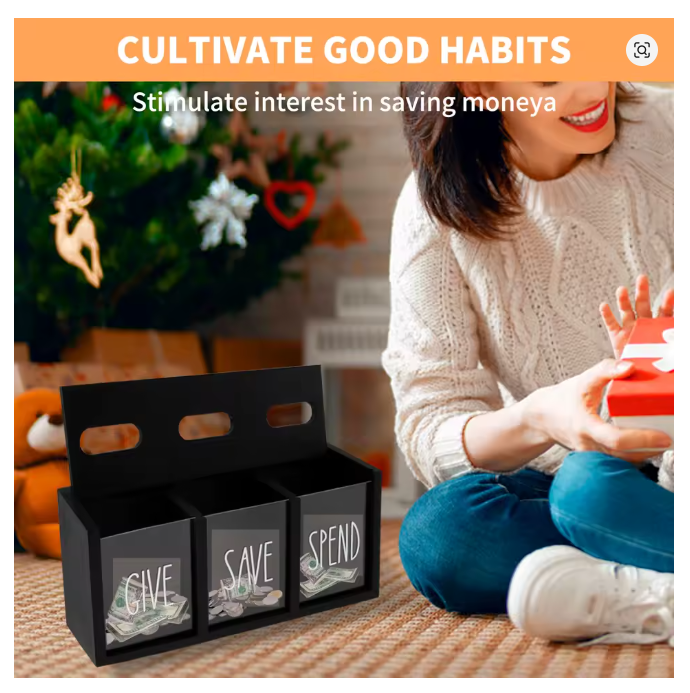
Through these three transparent vessels, a child learns far more than dry mathematics from an early age. Through tangible actions, they grasp the balance between immediate enjoyment, long-term stability, and an awareness of the world around them. They watch the pile in the saving jar grow slowly, and in doing so, they learn to respect the process.
The “Time Filter” Game: Translating the Price of Toys into Hours of Effort
When a child walks into a store and says, “Buy me this,” they do not see the work, energy, and time hidden behind that object. To them, it is merely a flash on a shelf. Instead of responding with an anxious “we can’t afford it” (which creates a sense of scarcity and fear in their mind) or giving in under pressure, we introduce the Time Filter game.
This is a direct translation of the life energy lesson onto a child’s level. First, during peaceful moments at home, we talk about how parents exchange their time and knowledge for currency. We can establish a basic family unit of effort. For instance, if your hour of focused work and creation in the marketplace brings a certain value, translate that into a simple ratio a child can understand.
The next time an impulsive desire arises for a toy that costs, say, $40, we do not enter into an argument. We sit down, take a piece of paper and a pencil, and calculate exactly how many hours of mom’s or dad’s work—spent in absolute concentration and effort—that toy actually costs.
“This toy racetrack is worth exactly 5 hours where mom or dad has to sit at the desk, designing or writing, instead of us playing in the park. Is this toy worth 5 hours of our shared time?”
This simple blueprint changes everything. The toy suddenly loses its magical luster and receives a real price expressed in human life. The child begins to understand the discipline of trade-offs: they realize that every impulsive item from the shelf directly takes away a piece of their family’s free time. Through this time filter, we do not teach children stinginess; we teach them to deeply value our effort, ensuring that tomorrow, when they grow up, they will mindfully measure what they buy and what they give in exchange for the things they own.
CONCLUSION: Your Blueprint for Progress (Less is More Checklist)
Financial peace is not a point on the horizon that you reach once and then stop walking. It is not a magical figure in a bank account that solves all internal dilemmas. Peace is a habit, a quiet discipline of the mind, and a series of intentional choices you make every single day when you decide not to surrender to consumer noise. This blueprint we have drawn together serves as a map for your inner liberation—a reminder that your life energy is the most precious currency you possess.
To maintain clear coordinates and bring structure to your daily routine, there is no need for complicated, heavy systems that introduce fresh unrest. Instead, copy this simple blueprint of progress into your personal, physical journal or your workspace. Use it as a cold-blooded archival record of your return to autonomy and ataraxia:
Your Matrix of Mindful Progress
| Step of Peace Architecture | My Local Goal and Record | Status (Done) | Date of Journal Entry |
| 1. The Hourly Wage of My Being | Calculated the real price of my hour of life | [ ] | _______________ |
| 2. The Noise Shield | Isolated the first calm shield ($1,000 beginner fund) | [ ] | _______________ |
| 3. The Financial Snowball | Listed all loose ends and cleared the smallest debt | [ ] | _______________ |
| 4. The Bulwark of Peace | Secured 3 to 6 months of living expenses on the side | [ ] | _______________ |
| 5. The Digital Land | Set up a domain and space for a personal project | [ ] | _______________ |
| 6. The Three Jars | Introduced the visual system of mindfulness for kids | [ ] | _______________ |
| 7. Automated Peace | Configured recurring transfers and stopped second-guessing | [ ] | _______________ |
When you fill in an individual field on this paper, shade it with your calming, olive green brand color. Your brain loves visual order, and each colored segment is a square of freedom you have bought back for yourself and your family.
Want this blueprint in a print-ready format?
Download Free PDF Blueprint (Checklist)For those among you who wish to transfer these journal steps into an advanced digital space free of unnecessary distractions, all these coordinate points, life energy filters, and habit-tracking systems have been integrated into one single place. You can deeply structure and track your personal progress within the ATARAXIA – The Autodidact’s Strategic Navigator Notion template, designed to serve as your quiet digital ally on the path toward inner freedom.
ATARAXIA
The Strategic Navigator for Autodidacts
A philosophical and strategic system designed for independent thinkers who want clarity, structure and intentional direction in a noisy digital world.
- Build a personal philosophy
- Organize knowledge intentionally
- Create strategic direction
- Escape mental overwhelm
Question of the Day
While analyzing this topic and recalculating the hours that seamlessly slip through our fingers, one naked question remains on the table, left today for your own reflection:
If your child, observing your daily habits and relationship with material things, had to draw a map for their own future life today, would that map lead toward permanent inner peace, or toward an eternal, frantic race for things that merely gather dust?
Frequently Asked Questions About Financial Peace & Intentional Living (FAQ)
How do I start learning about money if I have no background?
Financial literacy from scratch does not require an understanding of complex banking terminology or tracking stock market charts. The first step is always internal: a shift from theory to behavioral change. Instead of dry manuals, start by building awareness of where your unique life energy flows. List all your current debts and open lines on a single sheet of paper, and read foundational literature that changes your perspective on the value of time, such as The Psychology of Money or Your Money or Your Life. Knowledge stripped of noise is the best foundation for a stable blueprint.
How can I reduce financial stress and anxiety?
Reducing financial stress begins with identifying and eliminating small, constant drains on your attention—such as credit card balances, tech payment plans, or overdrawn accounts. When you apply the “financial snowball” method and mindfully clear these loose ends, you drastically reduce the number of channels consuming your capital and focus. The next step is isolating a specific “noise shield” (a fixed $1,000 beginner fund) that acts as a psychological barrier against unexpected expenses, allowing your mind to transition into a state of ataraxia.
What is “consumer noise”, and how does it affect mental health?

Consumer noise is the continuous pressure from your environment, social media algorithms, and aggressive marketing convincing you that you need to own more to be worth more. When you unconsciously enter this race, you begin exchanging your precious free time and hours of freedom for mere status symbols. This chronic fatigue directly damages your mental health and shatters your inner peace. Filtering this noise is achieved by running every potential purchase through a life energy filter—translating the item’s price into the real hours of life you must trade to possess it.
How do I create a one-page financial plan without feeling restricted?

A personal financial plan should never feel like a rigid, stressful diet that brings misery into your home. A successful one-page budget operates as an architecture of freedom. Instead of micromanaging every single cent with a sense of deprivation, consciously allocate your capital into clear, foundational categories at the start of the month (using a simple automated sub-account or cash-envelope system). Once your systemic boundaries are clearly drawn, constant second-guessing stops, leaving your mind free for creativity, deep work, and family.
How can I teach my children healthy financial habits early on?

Children learn best through play and by observing your actions, not through solemn lectures. To visually materialize the concept of currency in a cashless, digital era, introduce the three transparent jars method: Spending, Saving, and Giving. Through this tangible model, a child practices patience, delayed gratification, and empathy. Furthermore, when your child demands an impulsive toy from a shelf, implement the “Time Filter” game and calculate together how many hours of parental focus and effort that toy actually costs. This provides them with a lasting blueprint for a free life, immune to consumerist peer pressure.